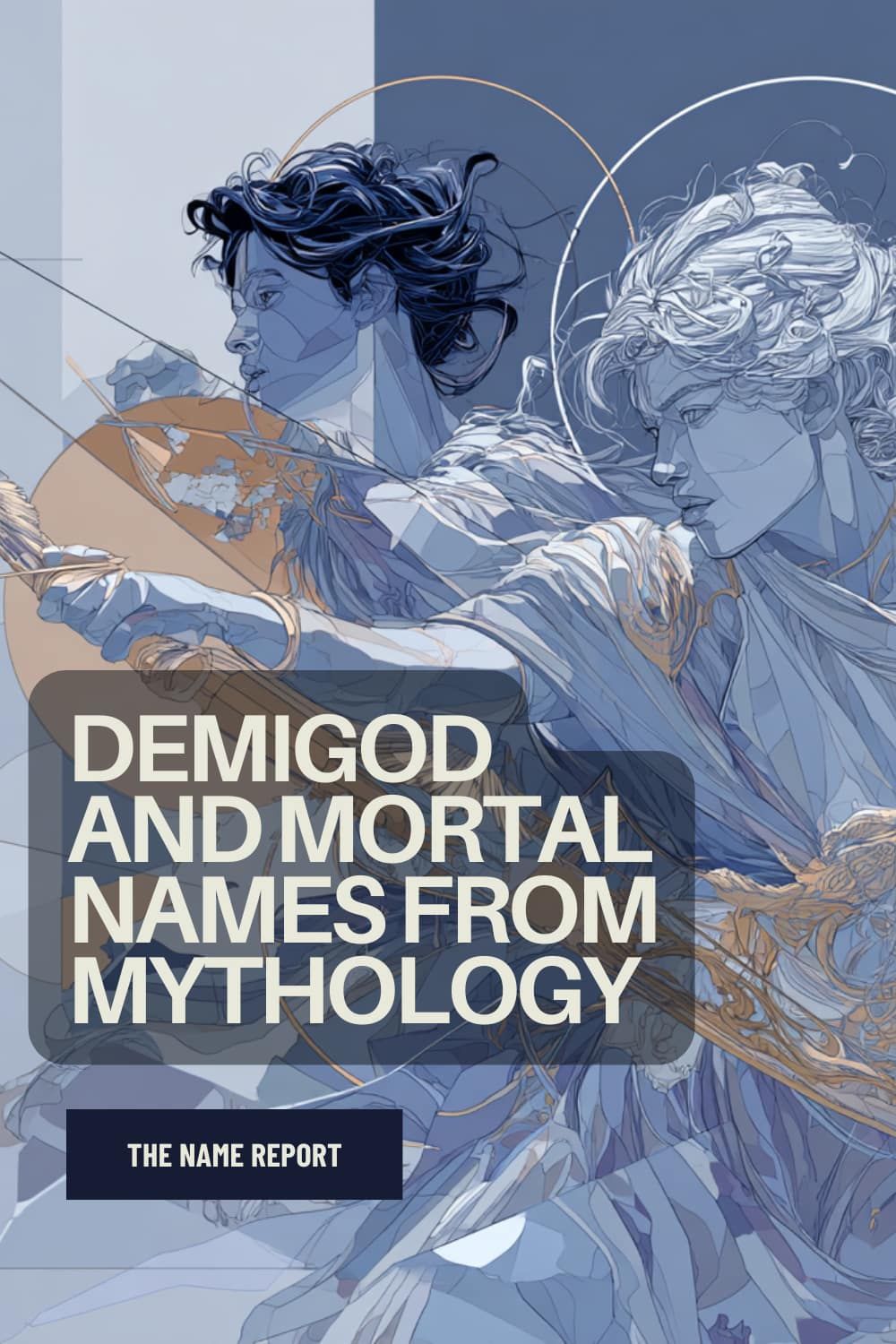
There’s a difference between naming your child after a god and naming them after a hero.
Gods are distant. They’re perfect (or perfectly flawed in ways that are larger than life). They’re mythological abstractions—concepts embodied as characters. When you name your child after a god, you’re invoking something eternal and untouchable.
But mortals and demigods? They’re different. They’re humans who touched divinity, who crossed into legend, who faced impossible odds and either triumphed or failed trying. They’re relatable in a way that gods aren’t.
Greek mythology gives you Athena. Norse god names give you Odin. But mythology across traditions also gives you Achilles—a mortal who was nearly invincible but died anyway. Helen—a mortal woman whose choice shaped history. Theseus—a mortal hero who descended into the underworld and returned.
These aren’t gods. They’re humans who became legendary. And naming your child after them is different—it’s saying: You don’t have to be perfect. You don’t have to be immortal. You just have to be brave enough to become mythological.
Like Norse goddess names, demigod and mortal names can challenge the expectation that power comes from divine birthright. Instead, they celebrate the human-scale.
What Demigods and Mortals Represent
A demigod is a hybrid—half divine, half human. They inherit power from a god parent but face the vulnerabilities of mortality. They’re caught between two worlds. They have extraordinary capability but also real stakes. They can be killed.
Mortals in mythology are even more grounded—they’re fully human, but they achieved something that elevated them to legendary status. They either earned their place in mythology through courage, cleverness, or resilience, or they simply had the bad luck to be caught in the path of divinity.
Both carry something important: the understanding that greatness is possible without being godlike.
They’re relatable. Your son doesn’t have to become a god to be heroic. He just has to face what’s in front of him and not back down.
They have real stakes. Unlike gods, who are essentially unkillable (even when they’re “killed,” they’re reborn or return), mortals and demigods actually face consequences. That consequence is what makes them heroic.
They’re human-scale. They struggle with the same things humans struggle with—mortality, doubt, the weight of expectation, the clash between what they want and what’s required of them. They’re just doing it at mythological scale.
They show what’s possible. Every demigod and mortal hero proves that humans can do extraordinary things. Not through divine right, but through will, intelligence, courage, and resilience.
Names from Greek Mythology: Mortals and Demigods
Greek mythology has some of the most compelling human-scale stories. The gods meddle, and mortals rise to meet the challenge.
Achilles (uh-KIL-eez)
Greek, possibly meaning “pain.” Achilles is a demigod—his mother is a sea nymph, his father a human king. He’s invincible except for one vulnerable spot (his heel). The mythology isn’t about his divinity. It’s about what he does with his human vulnerability. He chooses honor over safety. He fights knowing he’ll die. The name carries that weight.
Theseus (THEE-see-us)
Greek, possibly meaning “laid down” or “established.” Theseus is a mortal hero who descended into the underworld, faced the Minotaur, and returned alive. The mythology is about courage, strategy, and facing impossible odds as a human. Not as a god, but as a mortal who refused to accept limits.
Jason (JAY-sun)
Greek, meaning “healer.” Jason is a mortal hero who led the Argonauts on a mythological quest. He’s not the strongest or the most powerful—he’s the leader. He gathers heroes, he navigates impossible situations, he faces monsters and betrayal. The mythology shows what’s possible through leadership and determination.
Heracles/Hercules (HAIR-uh-kleez)
Greek, meaning “glory of Hera.” Heracles is a demigod—son of Zeus and a mortal woman. But the mythology doesn’t center on his divinity. It centers on the Twelve Labors—impossible tasks he accomplishes through strength and cleverness. The mythology is about persistence in the face of impossible odds. He’s literally doing the labors as atonement for a tragedy he caused. The name carries the understanding that you can come back from terrible things through work.
Odysseus (oh-DIS-ee-us)
Greek, meaning “one who hates” or “angry.” Odysseus is a mortal hero defined by intelligence and determination. The Odyssey isn’t about divine intervention—it’s about a mortal man using his wits to survive ten years of impossible circumstances and return home. The name carries problem-solving capability and resilience.
Helena/Helen (HEL-en or HEL-uh-nuh)
Greek, meaning “bright” or “shining.” Helen is a mortal woman whose beauty and choice shaped the Trojan War. But mythology doesn’t make her passive. She made choices. She had agency. Naming your daughter Helen is invoking a woman who was central to mythological events, not peripheral.
Andromache (an-DROM-uh-kee)
Greek, meaning “warrior woman.” Andromache is a mortal woman from the Trojan War—she’s known for her wisdom, her loyalty, and her strength in the face of loss. The mythology shows a woman who faced the worst circumstances with dignity.
Names from Norse Mythology: Mortals and Heroes
Norse mythology also has human-scale stories—mortals who faced giants and monsters and died fighting.
Sigurd (SIG-urd)
Norse, meaning “victory” and “protection.” Sigurd is a mortal hero who slayed a dragon, claimed treasure, and faced impossible moral choices. The mythology is about a human who achieved legendary status through courage and skill. He’s not a god—he’s a man who became mythological.
Beowulf (BAY-oh-woolf)
Anglo-Saxon, possibly meaning “bear” + “wolf.” Beowulf is a mortal warrior defined by his willingness to face monsters. He doesn’t have divine protection. He has courage, strength, and refusal to back down. The epic is about a human becoming legendary through his actions.
Brynhildr/Brunhilde (BRIN-hild)
Norse, meaning “armor” + “battle.” Brynhildr is a shieldmaiden—a mortal woman warrior. She’s not a goddess, but she’s legendary. The mythology shows a woman achieving legendary status through her own capability.
Names from Other Traditions: Mortals and Heroes
Perseus (PUR-see-us)
Greek, possibly derived from “to destroy.” Perseus is a demigod who killed Medusa and rescued Andromeda. His mythology is about a mortal-scale hero using intelligence and tools (not just strength) to accomplish impossible things.
Atalanta (at-uh-LAN-tuh)
Greek, possibly meaning “equal in weight.” Atalanta is a mortal woman—a huntress and athlete. She’s legendary because of her own capability, not because a god gave her power. She set her own terms. The name carries agency.
Arthur (AR-thur)
Celtic/British, possibly meaning “bear” or derived from Celtic roots meaning “noble.” Arthur is a mortal king (or possibly a demigod in some traditions) who unified Britain and faced impossible odds. The mythology celebrates human leadership and courage.
Gwyneth (GWEN-eth)
Welsh, meaning “fair” or “blessed.” Gwyneth is from Celtic tradition—a mortal woman with agency and power. She’s not a goddess, but she’s legendary.
Rama (RAH-muh)
Hindu, meaning “pleasant.” Rama is an avatar—a god in human form—but the Ramayana treats him as human. He faces human struggles, human doubt, human loss. The mythology is about doing the right thing even when it costs you everything. He’s a demigod treated as a mortal, which makes the mythology about human choice and responsibility.
Sita (SEE-tuh)
Hindu, meaning “furrow” or “line.” Sita is a mortal woman (or possibly divine in some traditions) who faces impossible circumstances with courage and agency. The mythology is about a woman maintaining her integrity through trauma.
Why Demigods and Mortals Matter in Naming
When you choose a demigod or mortal name, you’re not asking your child to be a god. You’re asking them to be brave.
You’re saying: You don’t have to be perfect. You don’t have to be born into divinity. You just have to face what’s in front of you and refuse to break.
This is different from names that mean king or names from actual royalty, which announce inherited authority. A demigod or mortal name announces earned authority—the understanding that you become legendary through your actions, not your birthright.
It’s also different from Norse god names, which announce unapologetic strength. A demigod or mortal name announces strength that’s tested, that faces real stakes, that proves itself through struggle.
It’s different from names that simply mean strength, which signal capability without context. A demigod or mortal name signals capability proven through impossible circumstances.
This matters.
It’s the difference between: “You’re meant to rule” and “You’re meant to become legendary through what you do.”
It’s the difference between: “You inherit power” and “You earn power.”
It’s the difference between: “You’re extraordinary because of who you are” and “You’re extraordinary because of what you choose.”
Mythology’s Human Scale: What We’re Rediscovering in 2026
There’s something happening in naming right now. Parents are moving beyond names that simply mean strength or names that announce power. They’re looking for names that embody something more specific: resilience through struggle, courage in the face of real stakes, the understanding that you don’t have to be born divine to be legendary.
Demigod and mortal names represent that. They’re mythology made human-scale. They show what’s possible without pretending it’s easy.
They also represent something deeper: the return to meaning-first naming. Not names chosen for sound alone, but names chosen because they carry a story—a story about courage, about crossing into legend, about achieving the extraordinary through being fully human.
The Test: Does This Demigod or Mortal Name Feel Right?
Not every hero name works for every child. The best ones are the ones that feel genuinely aligned with what you believe and what you want to communicate.
Does the story behind the name resonate with your values?
Achilles is about honor and courage in the face of mortality. Odysseus is about intelligence and persistence. Arthur is about leadership and unity. Rama is about duty and doing the right thing even when it costs everything. These are different stories. Which one speaks to what you actually value?
Does the name age well?
Achilles at seven and Achilles at seventy should feel equally right. The name shouldn’t feel like something your child will outgrow. Good demigod and mortal names carry weight across a lifetime.
Can your child inhabit it authentically?
Will your child feel like they have to perform the mythology? Or will the name feel like a natural expression of who they are? The best hero names are the ones your child can simply be in.
Does it honor the tradition it comes from?
If you’re choosing a name from a tradition that isn’t your family’s origin, understand the ethics of that choice. Are you honoring the tradition or performing it? Do you understand what the name actually means in its original context?
Demigods and Mortals: The Human Entry Point to Mythology
Mythology is vast and sometimes distant. Gods are abstract. But demigods and mortals? They’re entry points. They’re the places where divinity touches humanity and shows what’s possible.
When you name your child after a demigod or mortal hero, you’re not naming them toward godhood. You’re naming them toward legendary humanity. You’re saying: You don’t have to be born special. You just have to act like it matters.
That’s a different kind of power. That’s the kind of power any human can access.