Both are rooted in books. Both celebrate literary culture. But literary names and BookTok names represent two completely different relationships to literature—one timeless and enduring, one contemporary and trend-responsive.
Literary names draw from centuries of canonical tradition. BookTok names draw from what Gen Z is reading right now. They’re not the same thing, and the distinction matters because it affects how the name will age.
The Core Distinction
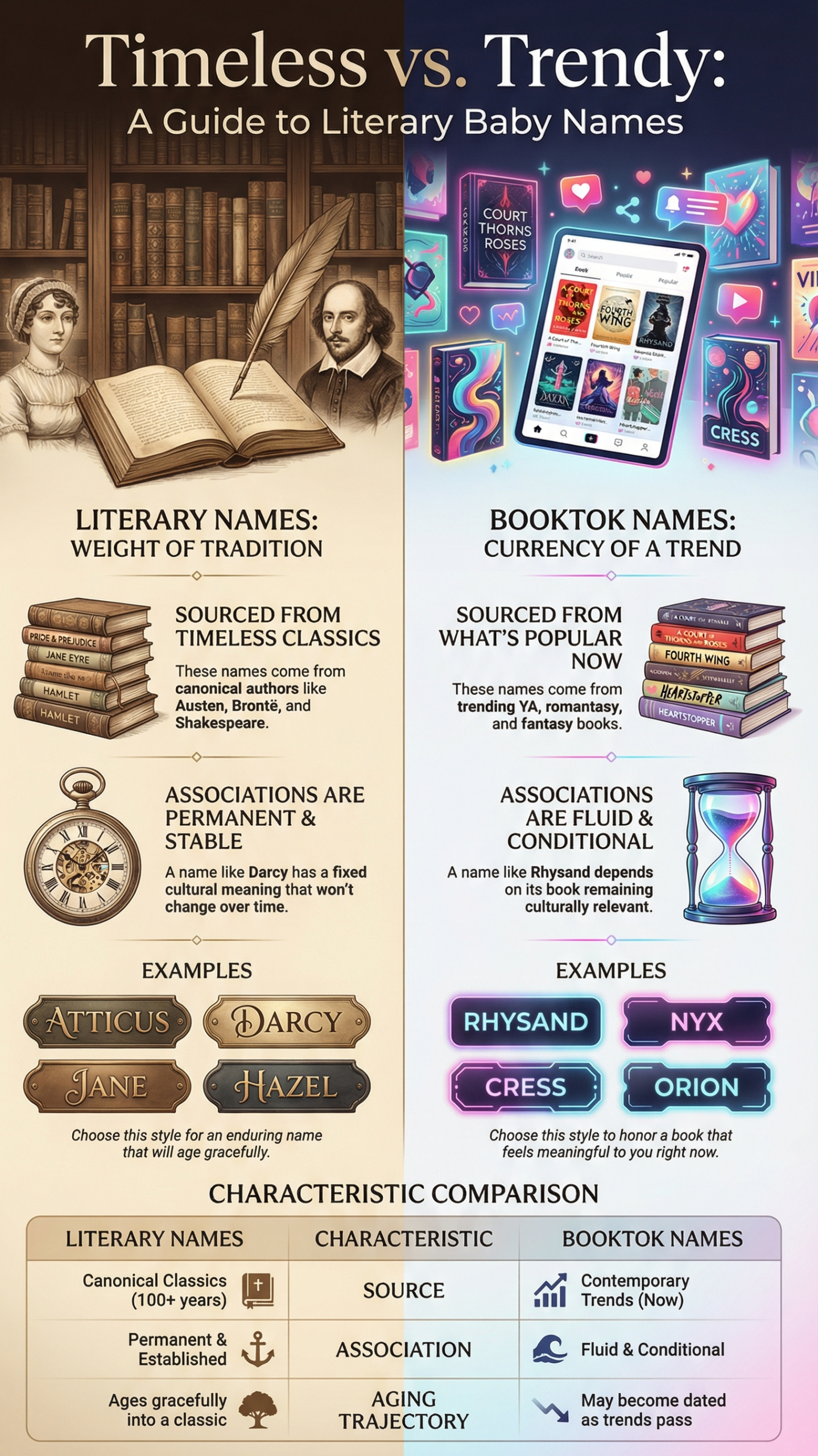
Literary is tradition-focused. These are names from canonical literature—Shakespeare, Austen, Brontë, Woolf—that have accumulated cultural weight over decades or centuries. The literary association is permanent. Atticus still means Harper Lee because that association is now cultural infrastructure.
BookTok is trend-focused. These are names from currently popular books—usually YA, romantasy, or fantasy—that Gen Z is reading and talking about. The literary association is current, which means it can shift. A name meaning one thing in 2025 might mean something else in 2035.
The names diverge significantly in how they function and age.
Visual Comparison Matrix
| LITERARY | BOOKTOK | |
| Source | Canonical literature (100+ year tradition) | Contemporary books (trending now) |
| Time Frame | Historical, established | Current, viral-responsive |
| Genres | Classics, literary fiction, spanning centuries | YA, romantasy, fantasy, BookTok-approved |
| Association Stability | Fixed (the association has calcified) | Fluid (could change as trends shift) |
| Age of Association | Decades/centuries old | 2-5 years old typically |
| Cultural Weight | Heavy, institutionalized | Present but developing |
| Names Feel Like | Someone shaped by reading classics | Someone reading what’s trending now |
| Aging Trajectory | Gets more literary as child grows | May become dated as trends pass |
| Parent Positioning | “I read these books as a kid” | “I read these books last year” |
Literary Names (Canonical Tradition, Established Weight)
These names carry the weight of canonical literature. Their associations are established—they’ve aged into cultural infrastructure.
Atticus — Harper Lee. The association is now permanent. The name functions with quiet confidence because the literary weight is institutional.
Austen — Jane Austen. The name works because literary tradition has made it substantial. The association is fixed.
Darcy — Jane Austen’s Pride and Prejudice. The literary weight is almost 200 years old. The association is permanent.
Hazel — Sylvia Plath, John Green, but primarily established through generations of usage. Works as a grounded name independent of current trends.
Jane — Charlotte, Emily Brontë; Jane Austen; Jane Eyre. The literary associations are so multiple and so old that they’re now just part of naming tradition. The name has transcended its literary origins.
Sherlock — Arthur Conan Doyle. The literary weight is established enough that the name works despite being unusual. The association is cultural infrastructure.
Zelda — F. Scott Fitzgerald’s wife and character, but now established enough that it’s its own identity. The literary association is there but not limiting.
Everett — Literary through association with literary names, but established enough through vintage boy names that it works independently.
BookTok Names (Contemporary Trends, Developing Weight)
These names are associated with currently popular books. The literary weight is real but developing—it could calcify like classic literary names, or it could fade if the book loses cultural relevance.
Rhysand — Sarah J. Maas’ A Court of Thorns and Roses. BookTok darling. The literary association is current but conditional—it depends on the book remaining culturally relevant.
Feysand (or variations) — Also Maas, also BookTok. The name is so trend-tied that it might feel dated in 10 years if the book’s cultural moment passes.
Nyx — Greek mythology, but popularized by BookTok through Maas. The association is current and tied to a specific aesthetic (dark romantasy). Could age depending on trend trajectories.
Cress — Marissa Meyer’s The Lunar Chronicles. BookTok-beloved, but the association is conditional on the book maintaining cultural relevance. Different from literary names because the weight is developing, not established.
Orion — mythology-based, popularized through BookTok. The name works, but the BookTok association is recent. The literary weight is thin compared to canonical literary names.
Piper — Rick Riordan’s Trials of Apollo. BookTok-adjacent. The literary association is conditional—depends on the book series maintaining relevance.
Lysander — Used in mythology and classics, but recently popularized through BookTok romantasy. The association is developing but not yet established like classic literary names.
How They Connect to Your Framework
Literary connects to:
- Literary Baby Names (broad category)
- Used Bookstore Literary Names (literary + cozy)
- Dark Academia Baby Names (literary + scholarly)
- Poetcore Baby Names (literary + intellectual)
- Poetry as a Prefix (literary + poetic)
- Names That Have Philosophical Weight (literary + substantial)
BookTok connects to:
- BookTok Baby Names (the direct category)
- BookTok Deep Cut: Fantasy Sub-Genres (specific BookTok subcategories)
- Romantasy Baby Names (BookTok-favorite genre)
- Dark Romantasy Names (specific BookTok aesthetic)
- Fae Names (BookTok-popular fantasy subgenre)
- Names That Mean Magic (BookTok aesthetic)
The Real Difference: Weight vs Currency
Literary names have weight. The literary association is old enough that it’s become cultural infrastructure. When you name your child Atticus, you’re tapping into 60+ years of consistent cultural meaning. The name will age gracefully because the literary weight is established.
BookTok names have currency. They’re trendy because they’re right now. When you name your child Rhysand, you’re tapping into a current cultural moment. The question is whether that moment will last. Will BookTok still be obsessed with Sarah J. Maas in 2045? Unknown.
This doesn’t mean BookTok names are bad choices. It means they’re conditional on cultural trends in a way that canonical literary names aren’t.
Choosing Between Them
Choose Literary if: You want your child’s name to carry enduring literary weight, to age gracefully because the association is established, to signal a connection to canonical tradition that will still be relevant in 30 years. You’re naming toward something that won’t shift.
Choose BookTok if: You’re genuinely connecting to a book that feels meaningful to you, not just following trends. You’re comfortable with the name’s meaning potentially shifting as culture evolves. You’re okay with it feeling dated in 20 years if the book loses cultural relevance. You’re naming toward a current cultural moment that feels important.
The distinction: Literary names are chosen for permanence. BookTok names are chosen for now.
Get Your Personalized Name Report
Deciding between literary tradition and BookTok trends? Want to ensure your literary choice won’t feel dated when the trend shifts? Get your Personalized Name Report at https://app.thenamereport.com/ and discover which literary approach authentically reflects your values.