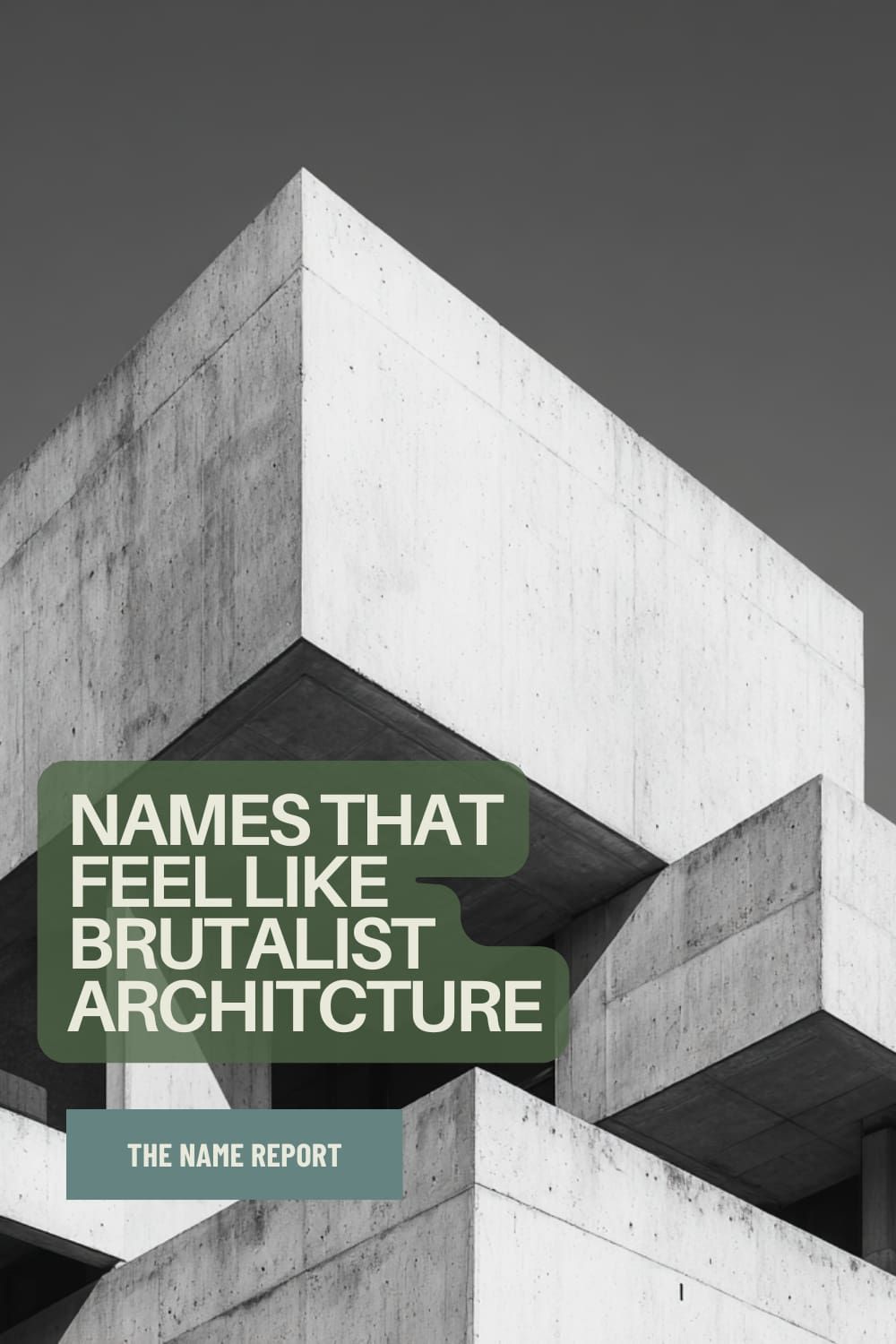
Brutalist architecture has a specific logic: honest materials, geometric severity, a refusal to apologize for what it is. Raw concrete. Exposed structure. Monolithic forms. Bold, angular, unadorned. It demands something of you—it doesn’t try to make itself pretty or easy. You either understand the power in that directness or you don’t.
Some names operate the same way.
They’re not delicate. They’re not trying to be charming. They’re names that stand as structural facts—angular, direct, uncompromising. They suggest someone who doesn’t perform softness, who values function over decoration, who understands that real beauty lives in honesty and form. They’re the naming equivalent of Boston City Hall: architecturally significant, visually arresting, and absolutely not for everyone.
These names work particularly well as gender-neutral choices because brutalism itself rejects the decorative gendering that clouds so much of naming tradition. A brutalist name is a name stripped of ornament. It exists purely as itself.
The Monolithic Names: Pure Form
Soren (SOR-en; Scandinavian: “stern, severe”) — Soren is what happens when you strip a name down to its essential geometry. No softening diminutives. No performance. The sound is like concrete—solid, unpolished, structurally honest. It works because it asks nothing of the listener except to accept its directness. For parents who understand that names don’t need to be decorative to be powerful.
Kael (KALE; Scottish/Irish origin, exact meaning debated but carrying “warrior” or “powerful” connotations) — Two syllables, hard consonants, immediate impact. Kael feels architectural—it’s the name equivalent of an exposed beam. It refuses softness. It’s increasingly being used across genders, which is exactly where brutalist naming goes: away from gendered decoration toward pure form.
Rory (ROR-ee; Irish: “red-haired king”) — Don’t be fooled by the apparent friendliness; Rory is brutalist in its refusal to diminish. It has weight. The double R, the hard stop of the Y. It’s been traditionally masculine but works as gender-neutral precisely because it doesn’t perform masculinity—it just is solid, present, unapologetic.
Finley (FIN-lee; Scottish: “fair-haired warrior,” though increasingly gender-neutral) — Finley is the brutalist name that appears conventional until you listen to it—there’s geometric precision in the structure. Finn as a standalone operates even more explicitly as brutalist: pure, monosyllabic, offering nothing extra. The -ley suffix adds slight softness, but the core remains unadorned.
Rowan (ROW-un; Scottish: rowan tree, but also functioning as derived from “red”) — The tree connection is real, but Rowan doesn’t feel nature-coded in the cottagecore sense. It feels structural. The double vowels create a shape—there’s something architecturally satisfying about the phonetics. It’s become genuinely gender-neutral while maintaining complete absence of decoration.
Morgan (MOR-gun; Welsh: “sea-born” or “great”) — Morgan is pure geometry in name form. One hard G. Clean syllables. No diminutives, no softening. The name doesn’t perform anything; it simply stands. Historically masculine, genuinely unisex, and increasingly the choice for parents who want something that doesn’t apologize for existing.
Ezra (EZ-rah; Hebrew: “help, helper”) — Ezra feels like clean lines and exposed structure. Two syllables, hard Z, hard R. There’s no diminutive form of Ezra—you don’t call someone Ezzie unless they choose it. The name exists in its completed form. It’s been experiencing genuine gender-neutral renaissance because it offers the same thing parents in other contexts seek: directness without decoration.
Indy (IN-dee; English: independent, or short for Indianapolis/Indiana) — Monosyllabic in essence (the Y is nearly silent). Indy is brutalist in its absolute refusal to be anything other than functional. It’s not a nickname pretending to be a name; it’s a name that operates as its own complete statement. Works across genders precisely because it’s so direct.
The Geometric Names: Angular Architecture
Hart (hart; English: “stag,” also archaic term meaning “heart”) — Hart is one syllable delivered like a fact. Hard consonants on both ends. The meaning is structural: a stag, an animal, something real and present. No softening. The name refuses to diminish itself through phonetics or expectation. It’s becoming increasingly used as gender-neutral for precisely this reason.
Kai (KY; Hawaiian/Japanese: sea, ocean) — Two letters masquerading as a complete name. Kai operates like architectural minimalism: total reduction. Nothing can be removed without destroying the form. It’s ungendered by nature and unadorned by necessity. The power comes from the absolute lack of excess.
Ash (ash; English: ash tree, but also unadorned moniker) — The name exists as pure function. One syllable. One clear meaning. Ash tree, ash residue—the word exists in multiple contexts but carries no decoration. As a name, it’s brutalist in its refusal to be anything ornamental. Works across all gender presentations.
Beck (bek; English: “small stream”) — Monolithic. Hard consonants. No diminutive form. Beck is what you get when you strip landscape down to geographic fact. A beck is literally a thing—a small stream in Yorkshire or Scandinavian geography. The name doesn’t perform; it refers. Its gender-neutrality comes from this absolute absence of performance.
Lex (leks; Latin/English: law, short for Alexander/Alexandra) — Three letters. Hard K sound at the end. Lex feels like exposed structure—there’s nothing to hide behind. It can be a nickname, but it functions as a complete name, which is the brutalist move. Stripped of the root name’s gender coding, Lex stands as pure form.
Quinn (kwin; Irish: “descendant of Conn”) — Two syllables with hard consonant closure. Quinn has been moving toward gender-neutral precisely because it offers no gendered decoration. The double N creates structural stability. It sounds like something architectural: clean, decisive, complete.
Sage (sayj; English: wise) — One syllable. The name as direct statement. Sage works because it offers nothing decorative, no diminutive softening, no gendered performance. It’s a quality and a name simultaneously, which is the brutalist approach: form and function as one unit.
The Rare Geometric Names: Architectural Risk
Cade (kayd; English: “cask” or “barrel,” origins debated) — Monolithic, hard consonants front and back, monosyllabic impact. Cade is unusual enough to feel intentional without being precious. It refuses both masculine softening (like adding -ie) and feminine decoration. It just exists as a geometric shape.
Scout (skout; English: scout) — One syllable that contains multitudes. Scout is inherently unadorned—it’s a role, a function, a word converted to name. Parents choosing Scout are choosing the brutalist principle: naming as functional statement rather than decorative choice. Works across all presentations.
Dash (dash; English: “quick movement” or “mark”) — Movement captured as monolithic fact. Dash refuses decoration through pure phonetic power. It’s a name that operates like brutalist graphic design: bold, striking, impossible to ignore. Aggressively gender-neutral because it offers no gendered signals whatsoever.
Blaze (blaytz; English: “flame”) — Hard Z closes the name decisively. Blaze is architectural in its angles—the Z creates a visual and phonetic corner. It’s not pretty; it’s powerful. It’s not decorative; it’s functional. It’s exactly the kind of name a parent choosing brutalist principles would select.
How Brutalist Names Work Differently
Against Cottagecore: Where cottagecore names offer gardens and warmth, brutalist names offer structure and consequence. Rowan in a cottagecore context feels nature-coded and soft; Rowan in a brutalist context feels architecturally necessary. The same name, deployed differently based on the values it represents.
Against Ornamental Gendering: Brutalist names resist gendered decoration because they don’t perform gender at all. They resist the -ia, -ie, -ette suffixes that traditionally feminine names use to signal softness. They resist the aggressive consonant clustering of traditionally masculine names performing power. They just exist—which is the most radical gender-neutral move of all.
Against Cuteness: Brutalism explicitly rejects the cute. It rejects the precious. It rejects the idea that beauty requires softness. A name like Scout or Sage doesn’t apologize for being short or unusual; it presents itself as architecturally complete. Parents drawn to brutalist aesthetics often reject cuteness in naming as they reject it in design.
For Parents Who Value:
- Honesty over decoration
- Structure over ornament
- Function over aesthetic appeal
- Directness over performance
- Durability over trend
These names offer something genuinely rare in contemporary naming culture: names that refuse to appeal to everyone, that demand something of the listener, that stand as structural facts rather than decorative choices.
The Consideration: Brutalist Expectations
Here’s what matters: if you choose a brutalist name, you’re signaling specific values. You’re saying this child will be direct. Structural. Honest. Strong. It’s not pressure exactly, but it’s a cultural signal. A child named Scout carries the weight of that architectural principle.
This is fine if those values actually matter to you. If you’re drawn to brutalist aesthetics—to dark academia‘s intellectual severity, to minimalist design’s refusal of excess—then a brutalist name aligns with your actual philosophy. But if you’re choosing the name because it sounds cool without understanding what it communicates, you’re missing the point. Brutalism is an ethic, not an aesthetic.
Names like Soren, Kai, Ezra, and Scout work precisely because they represent a refusal to compromise, a rejection of gendered decoration, an insistence on structural honesty. They’re not for everyone. They’re for parents who understand that some beauty requires severity, and that the most radical gender-neutral move is to stop decorating names at all—to offer them stripped of ornament, honest in their form.
If your aesthetic values align with brutalist principles—if you want your child’s name to stand as an architectural fact rather than a decorative choice—these names offer that possibility.
Ready to understand what your name choices reveal?
Get a Personalized Name Report that goes beyond surface aesthetics to explore what your naming preferences actually signal about your values, your design sensibility, and your vision for your child. Discover whether you’re drawn to brutalist honesty, ornamental tradition, or something else entirely. Find Your Perfect Name