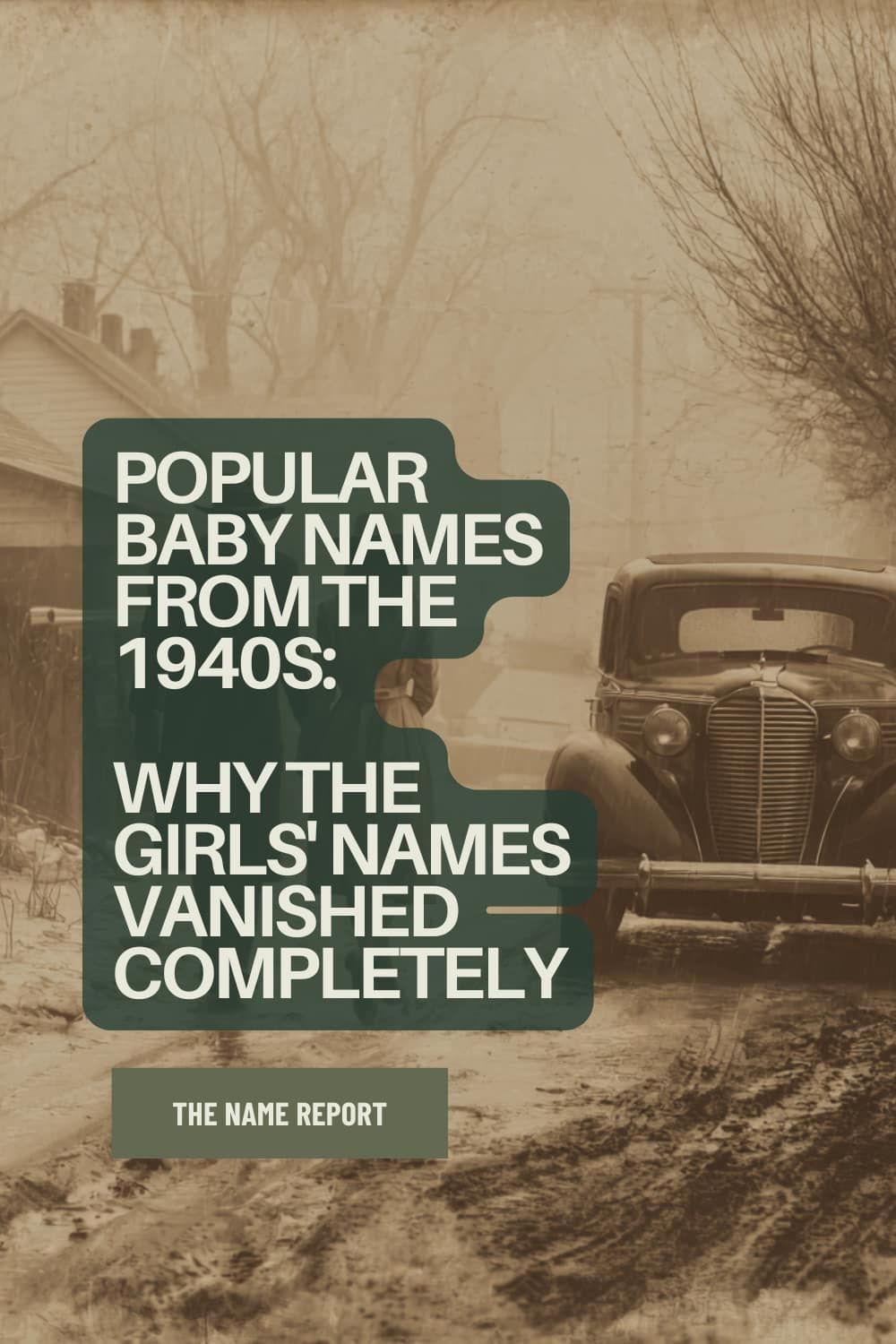
Something genuinely unusual happened between the 1940s and now: every single one of the top 10 girls’ names from that decade disappeared. Not faded. Not declined gradually. Disappeared. Mary, Barbara, Patricia, Carol, Margaret, Nancy, Judith, Joan, Betty, Donna—gone. None of them crack the top 100 today.
Meanwhile, the boys’ names? James is still #9. William still in the top 12. Robert hanging at #144. John at #40. The boys’ names weathered the entire cultural shift like they were built for it.
This isn’t random. This is a story about what happened to women’s names specifically, how the 1940s named girls completely differently than we name them now, and why that matters for parents trying to choose a name today.
The 1940s were split into two distinct worlds: the first half was World War II—everything was uncertainty, waiting, sacrifice. The second half was the Baby Boom, soldiers coming home, optimism, the future suddenly looking viable again. And the names given to girls across those two moments were shaped by something we don’t talk about much: the names chosen in the ’40s were names that were supposed to be safe. Recognizable. Traditional. They were names that wouldn’t cause friction.
Then everything changed.
Why the 1940s Got Quiet About Girl Names (And Why That Matters)
The top 10 girls’ names in the 1940s were dominated by the kind of names that don’t require introduction: Mary, Barbara, Patricia, Carol, Margaret, Nancy, Judith, Joan, Betty, Donna. They’re good names. They’re solid names. But they’re all variations on the same theme—short, sweet, traditional, completely predictable. They’re names that don’t ask for anything.
Compare that to now, when the top 10 girl names include Olivia, Emma, Ava, Sophia, Isabella, Mia, Charlotte, Amelia, Harper, and Evelyn. Look at that list. It’s wild by 1940s standards. Some of them are literary, some are nature-inspired, some are just unusual. Charlotte was #52 in the 1940s. Evelyn was #39. They were around, but they weren’t the choice. The choice was Mary and Barbara and Patricia—the names that meant safety.
So what happened? Why did we collectively decide that safe wasn’t the goal anymore?
Part of it is generational audacity. The children born in the 1940s—especially the Baby Boomers born in the latter half—had parents who had survived the Depression and the war. They weren’t playing it safe anymore. They had permission to be a little weirder, a little more adventurous. And when those Boomers had kids in the 1960s and 70s, they made completely different choices about girl names.
Part of it is cultural permission around femininity. The 1940s were still operating under the assumption that a girl’s name should be nice. Soft. Feminine in a very specific way. By the 1980s and 90s, parents realized that a girl’s name could be anything—it could be a surname, it could be nature-inspired, it could be uncommon. The category of “girl name” exploded.
Part of it is actual data. None of the top 10 girl names from the 1940s appear in the top 10 today. That’s statistically unusual. It suggests a genuine cultural break, not just a gradual shift.
The result? The 1940s girl names didn’t age well because we collectively decided they represented something we didn’t want to replicate—a kind of enforced conformity around femininity that felt suffocating once we had the option to move away from it.
The Boys’ Names That Stuck Around (Because They Always Do)
This is where it gets interesting. The boy names from the 1940s didn’t disappear. Some of them barely moved.
James — Was #1 in the 1940s, still #9 today. It’s been in the top 5 since the 1880s. This is a name that has staying power not because it’s trendy, but because parents keep coming back to it. There’s permission built into the name. You can be traditional or contemporary and still be James.
Robert — #2 in the 1940s, now #144. This is the biggest drop among the traditional top names, but it’s still hanging in the top 200. Robert was the #1 name for boys between 1925 and 1950. That’s 25 years of dominance. It’s only recently started declining, probably because it felt so overdone for so long.
John — #3 in the 1940s, now #40. Steady as ever. John was the most popular male Christian name for 400 years until the 1950s, when parents started getting creative. But it never actually left. It’s still solid. It still works.
William — #4 in the 1940s, now #12. This is the real success story. William managed to feel both traditional and contemporary. It works for a kid born in 1940 and a kid born in 2024. That’s genuinely rare.
The difference between the boys’ names and the girls’ names is stark: the boys’ names were built on a foundation that didn’t require shifting. They were strong enough, flexible enough, neutral enough to survive wholesale cultural changes. The girls’ names, by contrast, were built on conformity. Once we stopped valuing conformity as much, they became dated.
The Hidden Gems From the 1940s (The Ones Actually Worth Reconsidering)
But here’s where it gets good. Some of the 1940s names that weren’t in the top 10 are actually experiencing comebacks. These are names that were popular enough to be known, but not so popular that they feel overdone. And parents are starting to recognize them again.
Frances — Was #35 in the 1940s, now climbing steadily from #441. Judy Garland wasn’t technically Judith; she was born Frances Ethel Gumm, and Frances is having a genuine moment right now. It’s soft and literary, but it’s got backbone. And the Frankie nickname? That’s giving it contemporary edge. Parents are discovering that Frances works in 2025 in a way it didn’t in 1985.
Sylvia — Was #65 in the 1940s (peaking in 1937 at #50), now at #361 and climbing consistently since 2019. It means “of the forest.” In an era when nature-related names are having a major moment, Sylvia is perfectly positioned. It sounds literary, it’s got actual substance, and it’s rare enough that your kid won’t share it with half their class.
Bonnie — Was #33 in the 1940s, now at #441 and experiencing a real resurgence. This one completely left the SSA top 1000 between 2003 and 2014. It just vanished. But it’s back now, climbing steadily. Maybe it’s the -ie ending trend. Maybe it’s that Bonnie actually sounds like what it means—beautiful, approachable, genuine.
Eleanor — Was #31 in the 1940s, now climbing consistently. Eleanor Roosevelt basically gave this name its cultural weight, but parents are rediscovering it now as genuinely stylish. It’s old-money in the best way—not trying to perform wealth, just having it.
Judith — Was #4 in the 1940s, now basically vanished (currently ranked so low it’s nearly off the list entirely). This one is interesting because it was huge in the ’40s—Judy Garland and all—but the nickname Judy didn’t carry the same weight as the full name. Judith feels heavy now in a way that doesn’t read as contemporary. Maybe it needs another generation.
Evelyn — Was #39 in the 1940s, now experiencing a genuine resurgence in the top 20s. This one actually managed to survive the cultural shift and is now having a real moment. It’s got that vintage-but-contemporary quality that works across contexts. Evelyn stayed when almost everything else left.
Peggy — Was a top-100 name in the 1940s, now climbing again as parents rediscover diminutives. Peggy is like Betty’s slightly more refined cousin. It’s a nickname that became a first name (from Margaret), and it’s got that period-specific charm without feeling completely dated.
Betty — Was #11 in the 1940s (Betty Grable, Betty Boop, Betty Davis), now basically gone but experiencing minor uptick. Taylor Swift had a whole song about Betty on her Folklore album, which gave it a moment. But it’s still fighting the decade specificity. Betty feels 1940s in a way that Frances or Sylvia don’t.
The WWII Paradox: Hope and Anxiety Named Simultaneously
Here’s something worth sitting with: the 1940s were simultaneously the most optimistic and the most terrifying decade in American history. The first half was WWII—real danger, real uncertainty, real sacrifice. The second half was the Baby Boom—soldiers coming home, the economy exploding, the future suddenly looking possible.
And the names? They were quiet. Safe. Traditional. Almost like parents were using stable, recognizable names as a way of saying: This is still solid. This is still real. Even when everything else is uncertain.
The joke is that by the time the kids born in those quiet 1940s names grew up, they rejected the entire premise of quiet and safe. The Boomers born in the late ’40s went on to create a culture that was about anything but conformity and safety. They named their kids things like Jason and Jennifer and Brandon—completely different category of names.
So the 1940s girl names didn’t fail because they were bad. They failed because they were too successful at what they were trying to do—represent stability and safety—and then the culture moved on to wanting something completely different.
Why This Actually Matters for Naming Now
If you’re drawn to 1940s names, the lesson here is: don’t choose them for their vintage quality. Choose them for their actual substance.
Frances works now because it’s genuinely literary and strong. Sylvia works because it’s nature-rooted and has a cool sound. Bonnie works because it’s rare enough to feel distinctive and pretty enough to feel intentional. Eleanor works because it carries historical weight and actual credibility.
Betty, by contrast, will always feel a little like you’re making a choice about the 1940s, not a choice that happens to be from the 1940s. There’s a difference.
If you’re interested in names that navigate the line between vintage and contemporary, you might also explore our breakdown of names that feel new but are actually very old. Some of the best 1940s names work because they’re actually timeless, not because they’re vintage.
For more on how girl names specifically have evolved and why they’ve become more creative over time, check out the great vowel renaissance and our exploration of names that age well. There’s real data on why certain names stick around and others disappear entirely.
And if you’re thinking about the cultural context of names—what they represent, what they signal—our piece on the hidden class politics of baby naming digs into exactly that. Names aren’t just sounds. They’re cultural containers.
For comparison with other eras, check out our deep dive on 1930s names and our guide to 1920s names. Each decade tells a different story about what was happening culturally.
The Bottom Line: Sometimes Names Disappear For a Reason
Not every vintage name deserves a comeback. Some names age out not because they’re dated, but because they represented values or constraints we’ve moved past. The 1940s girl names didn’t vanish because they became ugly. They vanished because they represented a version of femininity that felt too narrow once we had permission to be wider.
But the hidden gems—Frances, Sylvia, Eleanor, Evelyn—these ones are actually experiencing revivals because parents recognize something real there. Not nostalgia. Real substance.
The 1940s boys’ names stuck around because they were built on a foundation that allowed for flexibility. James doesn’t demand anything. John doesn’t ask you to perform. William works whether you’re traditional or contemporary. That’s what made them stick.
The lesson? Choose names for what they actually are, not for the decade they’re from. If you love it because it’s genuinely good, it will work. If you love it because it feels period-specific, you might be setting yourself up for regret.
Ready to Find Your Kid’s Perfect Name?
The right name doesn’t feel like it’s from an era. It feels like it’s exactly right, right now, for your kid.
Get Your Personalized Name Report and discover which names actually fit your family—whether that means 1940s substance, contemporary innovation, or something that transcends time entirely. Because the best names aren’t historical. They’re personal.