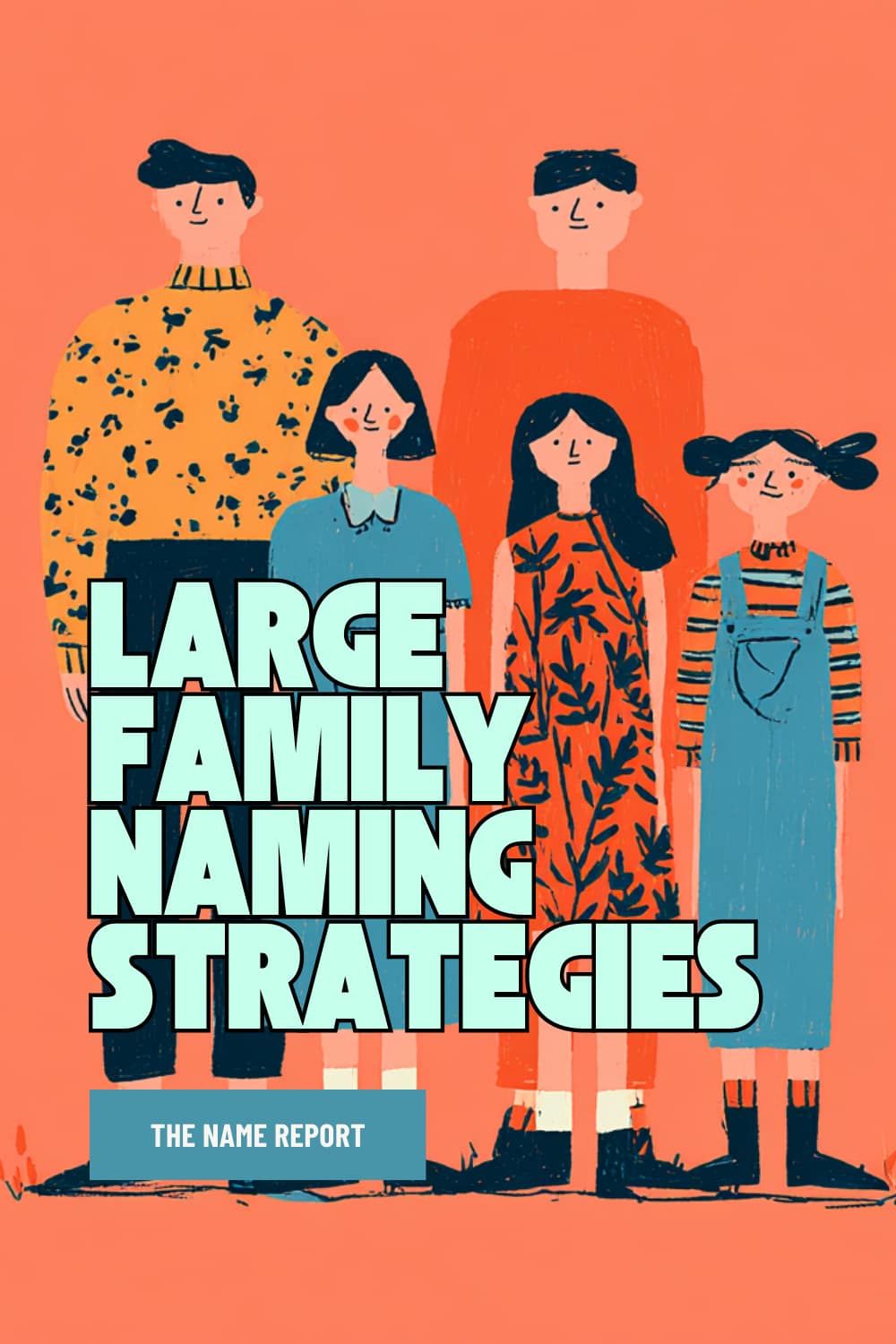
At two children, naming is a decision. At three, it becomes a pattern. At four or five or six, it’s a full-blown philosophy—one you’re managing in real time, often without having chosen it consciously.
The parents of large families talk about this moment: somewhere around child three or four, you realize your naming decisions have created a set of rules you didn’t mean to make. You named your first son Henry, your second son Theodore, your third son Arthur—and now you’re expecting a fourth boy and suddenly it feels like his name has to be Edward or George or something else from the same Edwardian-British-royals-adjacent universe, or the whole set falls apart. You’ve built a world. Now you have to keep living in it.
This post is for families navigating that world. Whether you’re planning ahead at child two or troubleshooting at child five, large family naming requires a different kind of thinking than singular naming—less about finding the perfect name and more about understanding what your names are actually doing together.
Why Large Family Naming Is a Different Problem
Naming one child, you’re asking: what name do I love?
Naming two children, you’re asking: what two names belong together?
Naming five children, you’re asking something much harder: what naming philosophy is internally consistent, flexible enough to accommodate different personalities and origins and aesthetics, and still produces a set that sounds like it came from one family?
The difficulty isn’t just accumulation. It’s that each name you choose narrows the field for the next one—and the constraints compound. By the fourth or fifth child, you may have inadvertently ruled out entire aesthetic categories, origin traditions, syllable patterns, or meaning types. This is why baby naming feels so stressful in general, and it intensifies with each subsequent child.
The three most common large-family naming problems:
The Aesthetic Drift Problem. Your first child’s name established one register (vintage-literary, say), but by child four you’ve naturally evolved your taste and the name you love for the new baby feels like it belongs to a different family.
The Exhaustion Problem. You’ve used all the names you loved. The favorites are taken. Child five gets the name that was always third on the list, and it feels like a consolation prize.
The Constraint Problem. The rules you created—accidentally or intentionally—have made the naming space so small that nothing feels right. Every candidate either breaks the pattern or feels like it’s trying too hard to fit it.
Understanding which problem you’re having changes how you solve it.
The Four Approaches to Large Family Naming
Before naming strategy, a meta-decision: what kind of coherence do you actually want?
| Approach | What It Means | Best For |
|---|---|---|
| Strict Thematic | All names from the same category (all saints, all botanical, all Latin) | Families who love commitment and symmetry |
| Aesthetic Family | All names from the same vibe or sensibility, different sources | Most families—maximum flexibility within coherence |
| Origin Consistent | All names from the same cultural tradition | Families honoring specific heritage |
| Structured Contrast | Deliberately varied, with one consistent rule (all same syllable count, all same first letter) | Families who want loose coordination without a theme |
| Fully Independent | Each name chosen without reference to the others | Families who prioritize individual identity over set coherence |
None of these is right or wrong. But most large families, when they’re honest, are trying to achieve Aesthetic Family coherence—names that feel like they belong together because of shared sensibility, not shared category. And that’s the hardest to achieve because it requires taste rather than rules.
The Color Palette Theory of Naming is worth reading before you go further—it’s the clearest explanation of what aesthetic coherence actually means in practice, and it gives you a vocabulary for diagnosing what’s going wrong when a candidate name doesn’t feel right.
Strategy One: Define Your Palette Before You Start
The single most useful thing a large family can do—ideally before child two, but workable even at child four—is to articulate the naming palette they’ve been operating in, even unconsciously.
This means writing down what your existing names actually share. Not what you think they share. What they actually share.
Take Henry, Theodore, and Arthur. What do they have in common?
- All three are English/British names with long histories
- All three have royal or aristocratic associations
- All three are three syllables with a strong-start-soft-end rhythm (HEN-ree, THEE-oh-dore, AR-thur)
- All three have excellent short-form nicknames (Hal/Harry, Theo/Teddy, Artie)
- All three are currently in the vintage-revival sweet spot—familiar but not overused
That’s your palette. It’s specific enough to be useful and broad enough to keep working. Names that fit: Frederick (Fred), Reginald (Reggie), Edmund (Ed), Clement (Clem), Auberon (Brin). Names that don’t fit: Jackson (surname-energy, American, no vintage revival quality), Axel (Scandinavian, hard-consonant, no British resonance), Bodhi (too new-age for this register).
Once you’ve defined the palette, candidates either fit it or they don’t. This removes much of the subjective agony from large-family naming and replaces it with something more like a checklist.
Strategy Two: Build in Flexibility From the Start
The families that handle large-family naming best are usually the ones who chose a wide enough palette at the beginning that it could absorb variation. The families that struggle are usually the ones whose palette is so specific that it becomes a cage.
Too narrow: All names from Irish mythology. (What happens when you have six boys and you’ve used Cian, Ruairí, Oisín, Fionn, Cormac, and Tadhg, and child seven is a girl?)
Wide enough: Celtic-influenced names with a wild, weather-worn quality. (This fits Irish mythology names but also Scottish names, Welsh names, Cornish names, and even some Scandinavian names with similar energy.)
Too narrow: All three-syllable Latinate names. (Works for three or four children; becomes a straitjacket at six.)
Wide enough: Names with classical European roots that feel both formal and warm. (This accommodates Latin, Greek, Italian, French, and even some Germanic names, giving you a much larger pool.)
The principle: define your palette at the level of sensibility and aesthetic quality, not at the level of specific category or origin. Intentional baby naming doesn’t mean rigid naming.
Strategy Three: Manage Syllable and Sound Variation Intentionally
In a set of five or six names, syllable patterns matter more than they do in a pair. When every name in a large family has the same syllable count, the set can start to feel mechanical—like a list rather than a family. When syllable counts vary wildly, the set can feel chaotic.
The ideal for most large families is deliberate variation with some pattern:
| Pattern Type | Example Set | Effect |
|---|---|---|
| Alternating short-long | Wren, Juniper, Fern, Sebastian, Nora, Theodore | Rhythm, contrast, natural variety |
| Anchoring with one short | Eleanor, Cecily, Harriet, Wren, Josephine | The short name stands out; the others cohere |
| Ascending length | Finn, Clara, Jasper, Beatrix, Josephine | Building scale, sense of accumulation |
| All two-syllable | Nora, Jasper, Clara, Felix, Hazel, Maren | Even, balanced, satisfying but can feel flat at six+ |
| Varied with one rule | All start with consonants: Thomas, Clara, Harriet, Jasper, Beatrix, Silas | Loose coordination, maximum variety |
The goal isn’t to follow a pattern—it’s to make intentional choices about sound and rhythm so the full set doesn’t feel accidental.
Strategy Four: Reserve Names, Not Just Names You Like
One of the most practical things large families can do: create a reserve list of names that fit your palette but that you’re holding back. Not just a general list of names you like—a specific list of names that work within your established aesthetic and that you haven’t used yet.
This prevents the Exhaustion Problem. When you’re naming child five in exhaustion and overwhelm, having a pre-vetted reserve list means you’re choosing from options you already know work, rather than starting the entire process over from scratch.
The reserve list should include:
- 5–8 names per gender that definitively fit your palette
- 2–3 names that are slightly outside your palette but might stretch it in interesting ways
- Notes on why each name is on the list (what makes it cohere with your existing names)
That last part—the notes—is what makes the list actually useful. When you’re exhausted and naming child four at 11pm, “Emmerich—German-vintage, similar register to Theodore and Jasper, nickname Em” is more useful than just “Emmerich.”
Strategy Five: Create Graceful Off-Ramps From Your Pattern
At some point in a large family, you may love a name that genuinely doesn’t fit your established palette. You’ve been naming British-literary children (Henry, Beatrix, Edmund, Cordelia) and you’ve fallen in love with Santiago for your fifth.
This isn’t a problem—if you handle it right. The mistake is trying to pretend it fits when it doesn’t, or abandoning a name you genuinely love because it doesn’t match. The solution is to treat the divergence as a feature rather than a bug.
Santiago belongs to the family because his parents loved the name and their naming philosophy has always been about depth and cultural weight—it’s just that the weight comes from a different tradition this time. The coherence isn’t sonic; it’s intentional. That’s a legitimate form of large-family coherence, and it often produces the most interesting sets.
The frame that works: your naming palette isn’t “British literary” or “Celtic traditional” or “Latin classical.” Your naming palette is “names we chose because they carry genuine cultural and historical depth, regardless of origin.” Under that framing, Santiago belongs with Henry and Beatrix and Edmund and Cordelia because all of them are names with stories. The palette is broader, and it absorbs the variation gracefully.
This reframe works for almost any divergence—as long as the new name meets the underlying standard your other names actually share, even if it doesn’t meet the surface-level category.
Common Large-Family Name Sets That Work
The British-Literary Set (5 children)
Henry, Beatrix, Edmund, Cordelia, and Jasper
Henry is the historical anchor; Beatrix is the literary-quirky; Edmund is the Narnia-Shakespeare choice; Cordelia is the Lear-Austen combination; Jasper is the geological-literary outlier that fits because it shares the vintage-British-eccentric quality. All five have cultural weight, all five have nickname potential, all five belong to the same aesthetic universe. Names that actually age well—the entire set passes the nursery-to-boardroom test.
The Vintage-Nature Set (4 children)
Hazel, Jasper, Wren, and Silas
Hazel is the botanical-vintage feminine; Jasper is the geological-vintage masculine; Wren is the bird-name that brings brevity to the set; Silas is the forest-and-faith biblical that anchors the whole thing in something more grounded than pure aesthetic. They share a sensibility (nature-rooted, vintage-revival, literary-adjacent) without sharing a category. This is the set that proves you don’t need a theme to have a philosophy.
The Celtic-Heritage Set (5 children)
Declan, Saoirse, Cormac, Niamh, and Ronan
For families with genuine Irish or Scottish heritage, committing to the Celtic tradition produces some of the most cohesive large-family sets possible—because the tradition is rich enough to sustain five or six names without repetition. Declan and Cormac are saints; Saoirse and Niamh are mythological; Ronan is the seal-son who bridges both. They share a cultural world, a linguistic texture, and the quality of names that reward pronunciation knowledge. The full guide to Irish girl names and Scottish girl names have extensive options for expanding this set.
The Biblical-Soft Set (4 children)
Ezra, Naomi, Silas, and Miriam
All four are Hebrew-biblical, all four are subtle rather than overtly religious, all four are currently in the sweet spot of familiar-but-not-overused. Ezra and Silas are the warm masculine anchors; Naomi and Miriam are the feminine names with depth and history. They share a softness and a gravity that feels both ancient and completely current.
The Latin-Classical Set (5 children)
Aurelia, Felix, Cecilia, Sebastian, and Vivienne
All five are Latin or Late Latin in origin, all five are currently in the vintage-revival sweet spot, all five have that European-classical warmth. Aurelia is golden; Felix is happy; Cecilia is musical; Sebastian is saintly; Vivienne is living-lively. The Latin origin is their deepest shared quality—but the palette also works aesthetically for families who weren’t thinking about etymology at all.
The Global-Intentional Set (5 children)
Amara, Soren, Paloma, Ezra, and Ingrid
Five names, five origins (Igbo/Yoruba, Danish, Spanish, Hebrew, Norse), one consistent quality: all five are names with genuine cultural meaning, chosen from traditions the family knows and respects. This set only works with cross-cultural naming ethics taken seriously—but when it does work, it produces a family set that reflects a genuinely worldly naming philosophy. The coherence isn’t sonic or categorical; it’s intentional.
Handling the Mid-Stream Course Correction
What if you’re at child four and you realize the pattern you’ve established isn’t working—or that your taste has genuinely evolved since you named child one?
First: it’s more okay than you think. Aesthetic shifts are real, they’re documented, and they happen to everyone. The name you loved for child one might feel slightly wrong to you now—that’s not a reflection on child one, it’s a reflection on how your taste develops over time.
The mid-stream course correction options:
Expand the palette definition. If you’ve been naming British-Victorian children and you’ve fallen in love with something Scandinavian, redefine your palette as “names with northern European weight and vintage revival quality.” The new name probably fits that broader definition even if it doesn’t fit the narrower one.
Let one name be the exception. A set of five with one genuine outlier is usually fine—especially if the outlier is the youngest, where it reads as the family having evolved rather than made an error. Children named Henry, Beatrix, Edmund, Cordelia, and Santiago are clearly from a family with strong naming opinions; Santiago’s difference reads as confidence, not inconsistency.
Use the middle name as a bridge. If the first name you love doesn’t fit the aesthetic, a middle name from your established palette can create a bridge. Santiago Edmund says: we went somewhere new, and we brought something familiar with us.
The Names You Keep Cycling Back To (And Why They’re Worth Trusting)
In large-family naming, there’s almost always a name that keeps coming back—a name that didn’t work for child one or two for some practical reason (too similar to a cousin’s name, partner wasn’t ready for it, initials were wrong), that’s been on the reserve list for years, and that now feels like it belongs to the next child.
Trust that name. Not blindly—run it through the sibling name test and make sure it still coheres with the names you’ve already chosen—but trust the fact that it has survived multiple rounds of consideration and still feels right. Names that do that tend to be the ones that belong to you in some real way.
The middle names with meaning post is worth reading if you’re trying to honor a family tradition or naming history while still giving each child a distinctive first name. And if you’re navigating the honor-name question specifically—a family name that doesn’t quite fit your aesthetic—how to modernize an “ugly” family name has a full framework for that specific problem.
A Note on Pressure and Permission
There’s a specific kind of social pressure that comes with large families: the expectation that your naming must be thematic. People will ask if all your kids’ names start with the same letter, or if they’re all from the Bible, or if they’re all from one country. They’re looking for the rule.
You don’t need a rule. You need a philosophy. Those are different things.
A rule is “all names start with J.” A philosophy is “we choose names that have genuine cultural weight and that we could defend on the grounds of history, meaning, and aesthetic quality rather than trend.” The philosophy produces a better set than the rule—and it survives six children in a way the rule doesn’t.
Names that signal values is worth reading if you’re thinking about what your naming choices communicate across a large family. And what your name choice says about your values as a family is the deeper cultural-criticism version of that same question.
Ready to find names for your specific family—with your existing names, your aesthetic, and however many children you’re planning? Get your Personalized Name Report. It’s built for exactly this kind of multi-name, long-game decision-making.